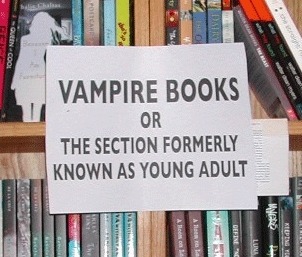
Though the image is funny, it also suggest a disturbing trend in literature. Why are there so many books being written about vampires as of late? More importantly, why do the vast majority of these circulate around the idea that having a blood sucking undead lover is appealing? Sure, Ann Rice touched on the idea in her various novels, Christopher Moore mocks this notion in his books Bloodsucking Fiends and You Suck (admittedly, Christopher Moore's novels are the only ones in this vein that I actually can stomach). These novels are well written, holding true to the original lore/legend associated with these creatures of the night, even if it is to merely mock them.
In contrast, the upswing in vampire popularity has led to a influx of novels that romanticize the vampire, almost to necrophalic (may not be a word, but I'm using it) levels. Enter the Twilight series. I am no fan of Ms. Meyer or her novels--ask any of my students, they hear the tirade any time the novels are referenced. I won't get into that, but I will say that if it doesn't burn up in sunlight, it isn't a vampire. Amidst all this vampire harlequin romance, there is a bright spot which has arisen. A new novel written by Academy Award Nominated director Guillermo del Toro and Acclaimed novelist Chuck Hogan, Strain.
I have been a fan of del Torro since he signed on to direct the first Hellboy film. I was blown away by Pan's Labyrinth and when I heard he was signing on to direct The Hobbit, I had a mini geekgasm. So, when my friend who manages a local book store told me that del Toro had a book coming out I was hooked before I even knew what the premise was. Strain is a vampire novel for a modern age. It takes into consideration all the lore and legend that Rice, Stoker, and a bundle of other authors draw from, debunking some of the more fantastic aspects (garlic, holy water, crucifixes) and spins some of the other aspects (elongated fangs, aversion to sun, thirst for blood) so that they are more thrilling to an audience which has been desensitized to violence through the new torture-porn film genre.
The basic plot goes thus:
On eve before a solar eclips, Dr. Ephraim Goodweather of the CDC is called in to investigate the mysterious events surrounding a Boeing 777 which lands at JFK international airport and immediately goes silent. When the plane is finally opened all of the passengers are discovered dead (save four) and a mysterious cabinet of dirt is discovered in the cargo hold but not registered on the manifest.
Dr. Goodweather begin his investigation assuming that a virus has been unleashed on New York. Through his investigation Goodweather meets Abraham Setrakian, a Jewish Holocaust survivor who knows more about the events surrounding the air plane incident and the virus than he may be letting on. Through their interaction Setrakian introduces Goodweather to "another v word: vampire."
The Strain is an gripping story that mixes fantasy and science to create a new take on the traditional vampire story. Though I thuroughly enjoyed the book, it is not without flaws. Let's start there and then move on to the good.
The Bad:
The biggest difficulty that I had with The Strain was the dialogue. As a writer I can attest to the fact that dialogue is the bane of the trade. Getting characters to speak in a manner that fits your vision and still seems natural to your audience is tough. What is often encountered is cliched interactions between characters that lead to predictable plot lines. While there is an element of predictability in the plot, the dialogue is stifled not by cliches but by an over abundance of "he said, she said" moments. Dialogue should have a natural flow. It assumes that each characters speaks in a way that distinguishes them, even minutely, from the other characters so that in situation of long back and forth dialogue the author can refrain from placing the "he said, she said" indicators after each sentence. This is not the case with The Strain. While the dialogue is strong on its own, Toro and Hogan use an over abundance of the "he said, she said" indicators to the point of annoyance and distraction.
I am an avid reader. I hate to out a good book down, but I found myself wanting to put down The Strain so that I could get away from the dialogue. I enjoyed the characters, but I felt insulted as a reader by the assumption that I could not figure out who said what to whom and when. I don't need to be led along and I doubt that the vast majority of their readers do not need to be led either. It was a little thing in the grand scheme, but it was a big distraction for me.
Part of this problem I attributed to translation; Del Toro is Spanish and I assumed that much of what he wrote had to go through some sort of translation process. The sentence construction both in the dialogue and the narration felt awkward, as if it was trying to force English language into Latin based sentence constructions. If you have ever learned to speak a different language it is apparent that English is not an easy fit, not everything translates over as fluidly as one would hope.
The other piece which I had a difficult time reconciling was the pace of the story. Del Toro is a brilliant director. His movies are visual masterpieces, and this is part of their immense appeal. The Strain attempts to take this same appeal and recreate it in text. While this is a great concept, the difference between text and film become quite apparent early on in the novel as heavy descriptions often begin to eclipse the narrative track. Transitions slip and some shifts in narrative are difficult to follow because there is little to nothing that prepares the reader for what is to come or follow. There are a few narrative tracks that are teased but not developed, and while that is expected to a degree because The Strain is the first book in a trilogy, the stories that are teased deal with minor characters that barely earn a passing nod in the entire 400 page novel. It is hard to imagine that these same characters will have any place in the future novels. While Del Toro uses this effect well in his movies (showing pieces of narrative that are off track from the main arc) this doesn't seem to translate as well into the written medium.
The Good:
I am a traditionalist. I love stories that are able to draw from and stay true to the original source material while making the new story unique. Books like Twilight, which take the most surface level aspect of the source material (this is a story about vampires) and them throws out everything that makes the original source material relevant (aversion to sun, garlic, flowing water, silver, etc.) are a waste of paper and time. Why claim to write a vampire novel if you are just going to change everything that makes them vampires? (I could go off on a very long tirade about how Ms. Meyer has ruined vampires forever, but I will refrain .... grumble grumble.) True, Del Toro and Hogan have changed the vampires that existed in Bram Stokers novel (and even Ann Rice's), the cliched blood sucking undead that is characterized by pale skin, elongated canines, and an affinity for long haired buxom virgins is replaced by a more realistic parasitic creature that is more bestial than suave.
Under the guiding hand of Toro and Hogan these vampires take on a more feral edge where their bodies go through a transition from revenant (mindless feral corpse seeking to fulfill its own bestial instincts and cravings) to full fledged vampire (we only get slight glances at what these creatures might be like). Archaic elements of the vampire myth (holy water and garlic) are debunked by Toro and Hogan for their overly fantastic nature (really, what good would a clove of garlic do against a threat as powerful and deadly as a vampire. Bad breath check, vampire defense not likely.) These vampires are seen as a virus like cancer which takes over a body killing it from the inside out and changing it to fit the dark needs of the its twisted desires. The turned are truly just shells housing the virus. For all their changes, the traditional elements of the vampire myth that Toro and Hogan maintain are very dynamic in what they contribute to the plot.
The "Ancient One" which introduces the vampire strain into NY via the plane is brought into the US by a wealthy benefactor with a desire to live forever. His addition to the plot created a humanistic twist to the spreading plague. The idea that humanity aligns itself with a villain of such power is not uncommon, but Toro and Hogan place a unique spin in the often cliched convention.
Overall:
This is a good novel. The story flows well despite the small hiccups that pp up from time to time, and as far as first novels go, Del Toro has created a world that is fantastic and believable. This a a vampire that I could exist, not one that would only exist under the most fantastic conditions. If you like vampire novels and are tired of the harlequin drivel that has become the standard recently, pick up this book. It will renew your belief that vampires are truly a threat, not a gemstone skinned Emo whose smoldering eyes burn their overly adjectival descriptions into your brain and cause your stomach to churn in disappointment. (Damn you Meyer!) The Strain is what a good vampire novel should be without wasting time on the trivial. I am excited for book number two, The Fall, which drops sometime after the first of the year.
Cheers,
Price


